
Does Strattera Cause Weight Gain? The Real Answer
When you're exploring a new medication like Strattera, it's completely normal to wonder about side effects, and weight is often at the top of that list. So, if you're asking, "does Strattera cause weight gain?" the clinical evidence offers a surprisingly clear answer: weight gain isn't a typical side effect.
In fact, many people have the opposite experience—a mild, temporary weight loss, particularly when they first begin treatment.
Unpacking the Data on Strattera and Weight

When you dig into the science connecting Strattera (atomoxetine) and body weight, the research consistently points away from weight gain. While every person's body is unique, large-scale studies show a clear pattern. Strattera is most often linked with either maintaining your current weight or experiencing a slight dip on the scale, especially in the first few months.
This makes it a distinct option in the world of ADHD medications, where weight changes can be a significant concern for patients and healthcare providers alike. The effect is particularly noticeable in children and teens, who might see a temporary slowing of their expected weight gain. For adults, it's usually a modest, short-term weight loss or just a neutral effect over the long run.
It's important to remember this is an average trend, not a guarantee for every single person. Still, it powerfully debunks the myth that Strattera is a medication that will make you add pounds.
The Clinical Evidence
Let's look at what the numbers actually say. The data from comprehensive clinical trials paints a very precise picture, and it’s not one of weight gain.
Short-term studies show that adults taking Strattera often experience the opposite. In controlled trials that ran for about nine weeks, adults on the medication lost an average of 0.4 kg (nearly one pound). In stark contrast, those taking a placebo actually gained an average of 1.5 kg (about 3.3 lbs). This highlights a definitive trend toward weight loss or stabilization, not gain. You can explore the FDA's official findings on Strattera's weight effects here.
The long-term data for younger patients tells an interesting story, too. Over a three-year study, children on Strattera who hadn't yet gone through puberty gained about 2.1 kg less than their predicted weight for their age. This shows a temporary slowing of their growth curve. However, this effect tends to even out over time as they move through puberty, with their weight gain eventually catching up to—or even exceeding—what was predicted.
To make this data easier to digest, here’s a quick summary table that breaks down the typical weight changes seen in clinical trials.
Summary of Strattera's Effect on Weight
This table summarizes the typical weight changes observed in different patient groups taking Strattera, based on clinical data.
| Patient Group | Short-Term Effect (First ~9 Weeks) | Long-Term Effect (>1 Year) |
|---|---|---|
| Adults | Modest weight loss (avg. 0.4 kg) | Generally weight-neutral |
| Children & Teens | Slowed rate of weight gain | Effect normalizes; weight often catches up to predicted curve |
This evidence clearly shows that concerns about gaining weight on Strattera are largely unfounded.
Key Takeaway: Strattera is not linked to weight gain. The most common effects are a slight, temporary weight loss in adults and a temporary slowing of expected weight gain in younger patients.
Now that we've established what happens, we can dive into why it happens by looking at how Strattera actually works in the body.
How Strattera Interacts with Appetite and Metabolism
To get why the answer to "does Strattera cause weight gain?" is almost always no, we need to look at how the medication actually works inside the body. It’s not magic; it's biology.
Strattera is part of a class of medications known as selective norepinephrine reuptake inhibitors, or NRIs. In simple terms, it works by increasing the amount of a key brain chemical—norepinephrine—that's available for your brain to use.
Think of norepinephrine as one of your body’s most important messengers. It’s deeply involved in regulating attention, alertness, and focus, which is exactly why Strattera is so effective for ADHD. But that’s not all it does. This same messenger also has a major say in controlling your appetite and how your body uses energy.
Norepinephrine and Its Effect on Hunger
When Strattera boosts the amount of active norepinephrine in your brain, it’s like turning up the volume on certain signals. One of the most important signals it amplifies is the one that tells your body you’re full or satisfied.
Imagine your brain has a kind of "hunger thermostat" that tells you when it's time to eat. Norepinephrine can essentially lower the setting on that thermostat, making you feel less hungry throughout the day. This is why a decreased appetite is one of the most common experiences when first starting the medication. It's a direct result of the drug's core function.
By keeping more norepinephrine active in your brain, Strattera can naturally quiet down hunger cues. This makes it easier to eat less without feeling like you're constantly fighting cravings, which is the main reason weight loss is a more common side effect than weight gain.
This mechanism is so well-understood that researchers are now exploring atomoxetine (the generic name for Strattera) for uses way beyond ADHD. For instance, a phase 2 clinical trial is currently looking into its potential to treat obesity linked to specific genetic mutations. Scientists believe its power to suppress appetite and switch on metabolic pathways makes it a strong candidate for weight management. You can find more details about this innovative obesity research and its progress.
A Boost to Your Metabolism
On top of reducing appetite, norepinephrine can also give your metabolism a gentle nudge. As a key player in the body's "fight or flight" response, it helps get you ready for action by tapping into your energy reserves.
While the effect from Strattera is much milder than a full-on adrenaline rush, it can still lead to a minor increase in your metabolic rate, meaning your body burns a few more calories even when you're at rest.
This creates a two-pronged effect that naturally works against weight gain:
- You eat less: With a reduced appetite, your caloric intake often goes down without you even trying.
- You burn more: Your body might be burning slightly more energy throughout the day.
When you put these two factors together, it becomes clear why clinical studies consistently show Strattera is far more likely to cause mild weight loss or simply keep your weight stable. The medication’s fundamental interaction with norepinephrine tilts your body's energy balance away from storing fat and toward using it for fuel. It’s a simple biological explanation for why weight gain is such an unlikely outcome.
Understanding Weight Changes in Children and Teens
For any parent, a new medication's potential effect on their child’s growth is understandably a top concern. When it comes to Strattera, the conversation isn't just about gaining or losing pounds—it’s about understanding a child's overall growth patterns.

Long-term studies show a specific and reassuring pattern. When children and teens first start Strattera, they often experience an initial slowing in their expected weight gain. This isn’t the same as losing a significant amount of weight. Instead, think of it as a temporary dip on their growth curve while their body adjusts to the medication's appetite-suppressing effects.
This initial phase can feel worrisome, but it’s so important to look at the complete picture over time. The evidence strongly suggests this is a temporary adjustment, not a permanent problem.
The Growth Curve and Catch-Up Period
Imagine a child's growth chart as a path they're expected to follow. When starting Strattera, some children might briefly step off that path, putting on weight a bit more slowly than their peers. But this is almost always followed by a "catch-up" period.
As their body gets used to the medication, their growth rate typically bounces back to normal. Over several months to a year, most kids return to their original, expected growth trajectory, effectively catching up to where they were predicted to be.
A clinical overview highlighted this exact trend. It noted that while some young patients initially lost a small amount of weight—averaging about 0.5 kg (1.1 lbs)—those who continued the treatment for at least 18 months resumed their normal weight gain patterns. In fact, clinical data suggests Strattera is unlikely to have a lasting impact on growth or affect their final adult height.
Why Consistent Monitoring Is Key
Because of this initial adjustment period, careful and consistent monitoring by a healthcare provider is absolutely essential. Tracking a child's height and weight over time provides the context needed to see the whole story.
This kind of monitoring helps distinguish a temporary, expected side effect from any other issue. It allows your provider to see the full arc of the growth pattern—the initial dip and the rebound—which provides peace of mind for parents. It also reinforces why keeping an open line of communication with your healthcare provider is so crucial. For families looking for supportive health strategies, our guide offers some helpful 5 weight loss tips for a healthier 2024 that can complement overall wellness.
Ultimately, the goal is to ensure the medication manages ADHD symptoms effectively without creating long-term problems. The overwhelming majority of data shows that while Strattera may cause a temporary slowdown as a child's system adapts, it doesn’t stand in the way of their overall growth.
Strattera vs. Other ADHD Medications on Weight
To really get a feel for how Strattera might affect your weight, you have to look at the bigger picture. Context is everything. When it comes to ADHD medications, there are two main teams on the field: non-stimulants like Strattera, and stimulants like Adderall or Ritalin.
These two types of drugs work in fundamentally different ways, and that difference is what directly shapes their impact on appetite and weight. It's often the deciding factor when a healthcare provider is trying to find the right fit for a patient.
This infographic lays out some key data on Strattera's weight effects.
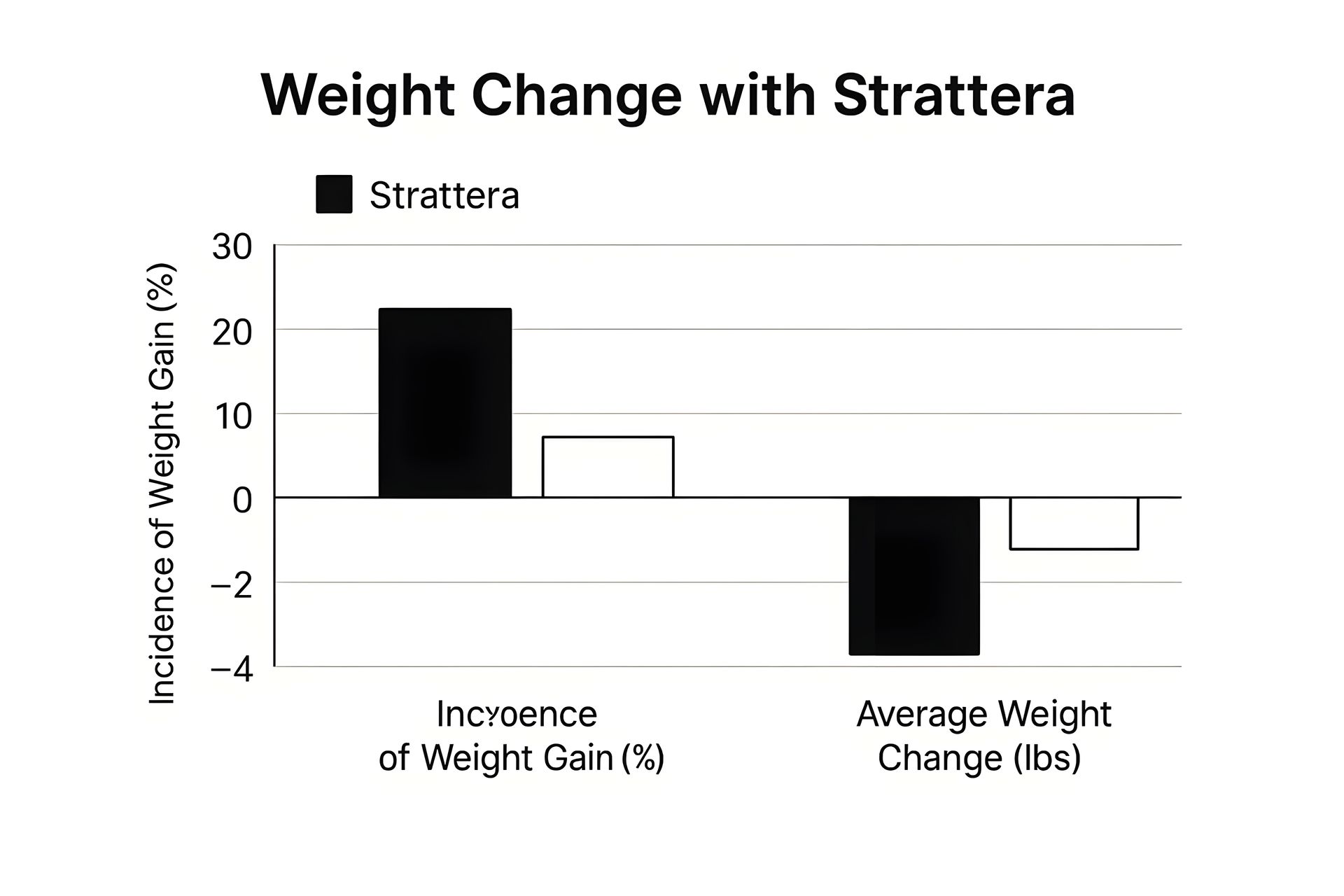
As you can see, the data points toward weight loss, not gain, as the more frequent outcome when you put Strattera head-to-head with a placebo.
Comparing Stimulant and Non-Stimulant Medications
So, what’s the core difference here? It all comes down to brain chemistry.
Stimulant medications work by cranking up the levels of two key brain chemicals: dopamine and norepinephrine. This one-two punch is incredibly effective for managing ADHD symptoms, but it also sends a much stronger signal to the body's appetite control center. The most common result is significant appetite suppression, which often leads to weight loss.
For some people, this is a major problem. If someone is already underweight or if a drop in appetite could interfere with their health or performance, this side effect can be a deal-breaker. It's not uncommon for this to be the primary reason someone stops taking a stimulant.
Strattera, on the other hand, takes a more targeted approach. As a selective norepinephrine reuptake inhibitor (NRI), it zooms in on just one of those brain chemicals: norepinephrine. Because it leaves dopamine alone, its effect on appetite is generally much milder and often fades over time.
To make this comparison clearer, here's a simple breakdown of how these medications stack up when it comes to weight.
Weight Effects of Common ADHD Medications
| Medication Type | Examples | Primary Mechanism | Common Effect on Weight |
|---|---|---|---|
| Non-Stimulant (NRI) | Strattera (Atomoxetine) | Increases norepinephrine only | Mild, often temporary appetite suppression; slight weight loss is more common than gain. |
| Stimulant | Adderall, Ritalin, Vyvanse | Increases dopamine and norepinephrine | Significant appetite suppression; moderate to significant weight loss is common. |
This table highlights the key distinction: stimulants hit the appetite "off switch" much harder, while Strattera's effect is far more subtle.
Why a Healthcare Provider Might Choose Strattera
A good healthcare provider will weigh a ton of factors before recommending an ADHD medication. If a patient—or their parent—raises concerns about potential weight loss or the importance of maintaining a healthy appetite, Strattera immediately becomes a leading option.
Here are a few situations where Strattera's gentler profile is a real advantage:
- For individuals with a history of eating disorders, where the strong appetite suppression from stimulants could be a serious trigger or risk.
- For athletes or anyone with high physical demands who must maintain a specific calorie intake to fuel their performance and energy.
- For patients who've had a bad experience with stimulants, including side effects like feeling "zombified" or dealing with severe appetite loss.
Ultimately, choosing an ADHD medication is a team decision between you and your healthcare provider. This comparison just helps show why Strattera has carved out such a unique and valuable spot in the treatment playbook, especially when weight is part of the conversation. In the same way, understanding how different modern medicines work is key, which is why learning what Ozempic is and how it interacts with cannabis can give you a better grasp of the broader landscape of medical treatments today.
Managing Unexpected Weight Changes on Strattera
While the clinical evidence is clear that Strattera isn't a medication known for causing weight gain, any unexpected shift in your body can still be worrying. If you notice your weight moving in a direction that feels uncomfortable, it’s important to handle it proactively with the right support.
Your first and most critical step is always to speak with your healthcare provider. Never try to adjust your dose or stop taking a medication on your own. A good, open conversation with your healthcare provider is the foundation for finding a solution that truly works for you.
Developing Proactive Health Habits
Even though Strattera is unlikely to be the direct cause of weight gain, managing ADHD often means building routines that support your entire well-being. Focusing on healthy habits helps you feel more in control and supports your physical health, whether you're on medication or not.
These habits create a strong foundation for both mental clarity and physical wellness. For anyone in Mississippi interested in a more structured path, understanding what is medical weight loss can offer valuable insights into programs guided by physicians.
Simple, consistent actions can make a huge difference. Think about weaving these strategies into your daily life:
- Mindful Eating: Tune in to your body’s signals for hunger and fullness. ADHD can sometimes trigger impulsive or distracted eating, so just taking a moment to focus on your meal can help you avoid overeating.
- Prioritize Hydration: Staying hydrated is key for your metabolism and energy. Sometimes, our brains mistake thirst for hunger.
- Incorporate Movement: You don't need intense gym sessions. A daily walk, some stretching, or finding a fun activity you enjoy can boost your mood, sharpen your focus, and help maintain a healthy weight.
Preparing for a Productive Healthcare Visit
When you bring up weight concerns with your provider, a little preparation can make the conversation much more effective. The goal is to work together as a team to find the best path forward for your health.
Key Insight: Your healthcare provider is your partner. Bringing clear information helps them understand the full context of your experience and offer the best possible guidance.
Before your appointment, try to gather some specific details to share. This helps your provider see the complete picture of what's been going on.
What to Track and Bring:
- A simple log of your weight changes over a few weeks or months.
- Notes on any shifts in your diet, appetite, or eating habits.
- A list of your current activity levels.
- Any other new or changing symptoms you've experienced.
By taking these proactive steps, you can confidently manage your well-being while taking Strattera and make sure your treatment plan fully supports your overall health goals.
Frequently Asked Questions About Strattera and Weight

Starting any new medication can bring up a lot of questions, and that’s completely normal. When it comes to Strattera and its potential connection to weight, we hear a lot of the same concerns from patients. Let's clear things up with some straightforward answers to the most common questions.
Can Strattera Cause Weight Gain After You Stop Taking It?
This is a common worry, but there’s no clinical evidence showing that stopping Strattera leads to some kind of "rebound" weight gain. When you discontinue the medication, its effects on your appetite simply fade away.
If you happened to experience some appetite suppression while taking it, your appetite and weight will likely just return to your personal baseline. Think of it as your body simply going back to its normal state, not a new side effect caused by stopping the drug.
Does the Dose of Strattera Affect Weight Changes?
It can. The impact on appetite is often dose-dependent, which means some people might notice more appetite suppression at higher doses. That said, the goal of treatment is always to find the lowest effective dose for managing ADHD symptoms, not for influencing weight.
Any adjustments to your dose should be made carefully with your healthcare provider. They’ll work with you to find the right balance between the medication's effectiveness and any side effects, including changes in your appetite.
Important Note: A comprehensive treatment plan considers all aspects of your well-being. For some in Mississippi, this may include exploring how a medical Marijuana card can help manage qualifying conditions alongside other prescribed treatments. Obtaining a card allows legal access to medical Marijuana, which some patients find beneficial for symptoms like anxiety or sleep issues that can accompany ADHD.
Are Adults or Children More Likely to Have Weight Changes?
Most of the in-depth research we have on Strattera and weight has focused on children and adolescents. In that group, a temporary slowing of expected weight gain is a well-documented initial effect as their bodies adjust.
Adults might also notice some mild appetite suppression when they first start the medication. However, because adults aren't in a phase of rapid growth, the effect is typically much less pronounced. For most adults, Strattera is considered to have a neutral long-term impact on weight.
Is It Safe to Take Strattera If I Am Already Underweight?
This is a critical conversation to have with your healthcare provider. Because Strattera has the potential to decrease appetite, your provider will need to carefully evaluate your overall health and current weight before prescribing it. It's a matter of safety first.
They may recommend closer monitoring of your weight and suggest strategies to make sure you're getting enough nutrition. In some situations, they might decide that another ADHD medication is a more suitable and safer choice for your specific needs.
At Pause Pain and Wellness, we believe in a complete approach to health. Our Mississippi-based providers can help you explore all your options, from managing ADHD to understanding if a medical Marijuana card is right for you. Find personalized care by visiting us at https://pausethepain.com.