How to Overcome Social Anxiety in Mississippi
Overcoming social anxiety starts with recognizing your triggers, questioning those negative thoughts, and gently stepping into social settings. At its core, it’s about building self-awareness and confidence so the fear of judgment loses its grip.
Key Strategies To Begin Your Journey:
- Mindfulness Exercises to anchor you in the present moment
- Self-Confidence Boosters such as keeping a daily wins journal
- Mini Exposure Tasks in low-pressure environments
- Reflective Practices that help you spot and challenge negative ideas
Understanding Social Anxiety In Today's World
Social anxiety goes beyond simple shyness. It’s the constant worry that eyes are on you, grading every move. Whether you’re grabbing groceries in Jackson or chatting at a Biloxi festival, it can feel like a spotlight you never asked for.
That kind of stress makes you want to hide. But remember, you’re far from alone. Modern routines and nonstop comparison on social media can amplify these feelings.
Why Social Anxiety Is So Common
Recent surveys show these worries are more widespread than many realize. A 2020 international study found that 36% of young adults meet the criteria for Social Anxiety Disorder. Even more eye-opening: about 18% of those individuals didn’t recognize it in themselves. For full details, check out the research on social anxiety.
The root cause is often the dread of negative evaluation, and here’s how it shows up:
- Fear of Judgment: Believing every glance is a critique
- Physical Response: Blushing, sweating, trembling, or a racing heart
- Avoidance: Skipping events or outings to dodge social situations
- Ruminating: Replaying conversations for hours and second-guessing every word
Social anxiety isn’t about wanting to be alone; it’s the fear that holds you back from real connections. Recognizing these patterns is your first step toward reclaiming confidence.
This overview is meant to show that these feelings are signals, not personal failings. Recognizing them opens the door to real, Mississippi-friendly tactics. Next, we’ll explore practical steps designed to make social interactions feel less daunting.
Practical First Steps to Reclaim Your Confidence
Feeling overwhelmed by social anxiety is a common experience. It can feel like an insurmountable wall, but you have the power to start chipping away at it, piece by piece, starting today. This isn't about reciting theories; it's about building a real-world toolkit with strategies you can actually use to take back control.
The first step always feels like the hardest, but it doesn't have to be some monumental leap. It’s the small, consistent actions that truly build momentum and, most importantly, confidence over time. This way, you’re gently stretching your comfort zone, not snapping it.
Start with Gentle Exposure
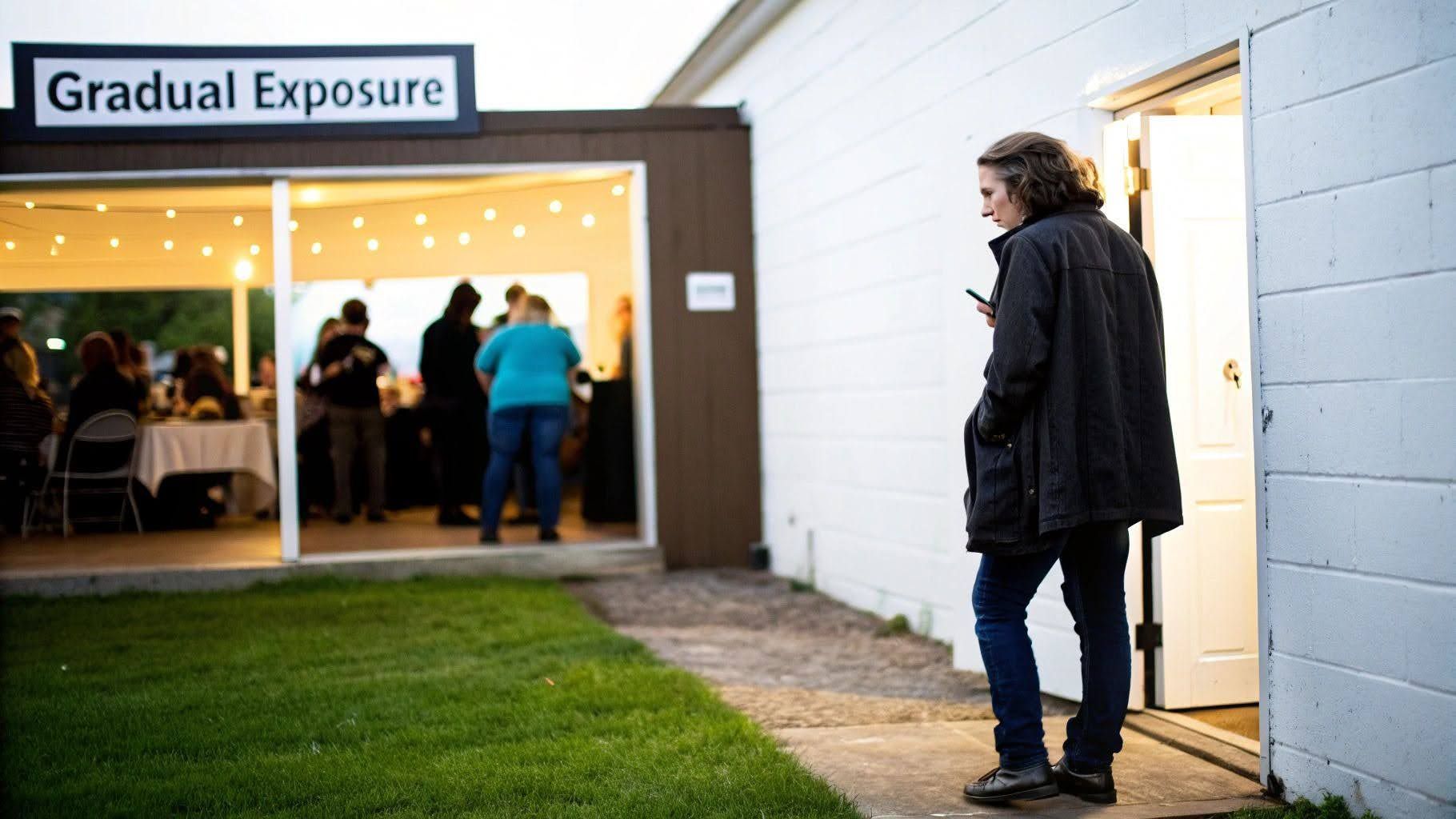
One of the most effective ways to begin is through something called gradual exposure. Forget about diving into the deep end by forcing yourself into a high-stakes party. Instead, think small. What's a quiet activity that lets you be around people without the pressure of direct interaction?
For instance, you could start with a simple walk through a local Mississippi park, maybe Shepard State Park in Gautier on a quiet weekday afternoon. The only goal here is to get comfortable just being in a public space. Once that feels okay, you can level up slightly. Maybe try a weekend farmers market in a town like Oxford or Hattiesburg.
The key is to challenge yourself just enough to feel a little stretch, but not so much that you trigger a full-blown anxiety response. Every small win builds on the last, proving to yourself, "Hey, I can handle this."
Learn to Ground Yourself with Mindfulness
When that familiar spike of anxiety hits, your thoughts can start racing, making you feel completely disconnected from reality. This is where mindfulness techniques come in—they are lifesavers for pulling you back to the present moment. One of the most straightforward and powerful methods is controlled breathing.
This image shows a simple grounding technique, mindful breathing, that you can practice anywhere to dial down the anxiety.
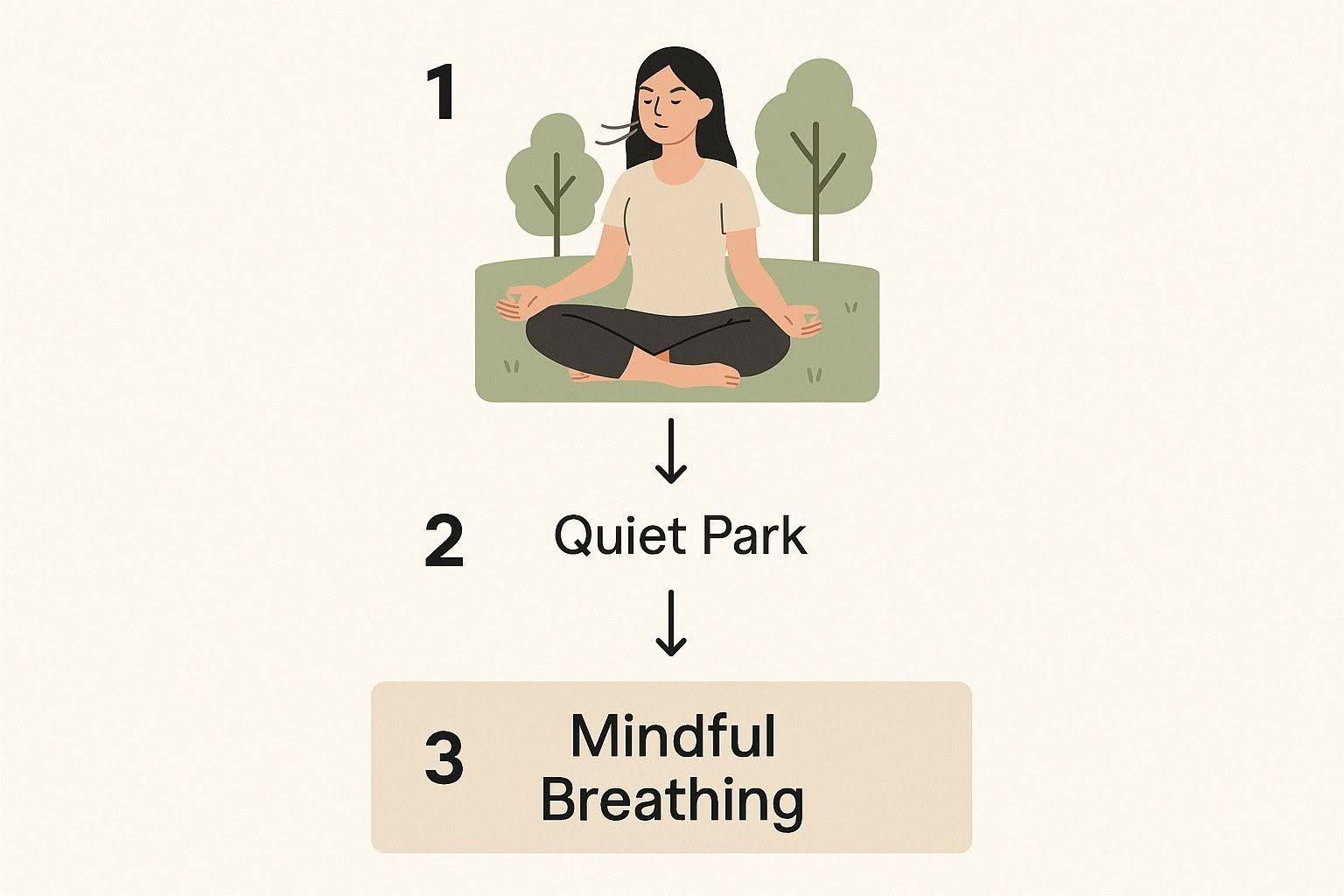
Simply visualizing a calm place while you zero in on your breath is an incredible tool for interrupting the anxiety cycle before it really gets going.
Challenge Your Automatic Negative Thoughts
Social anxiety often runs on a nasty fuel source: automatic negative thoughts (ANTs). These are the instant, critical judgments that pop into your head—"Everyone is staring at me," or "I'm definitely going to say something stupid." They feel incredibly true in the moment, but they rarely are.
A technique called cognitive reframing is all about learning to challenge and change these ANTs.
When a negative thought pops up, walk through these steps:
- Catch the thought: First, just notice it. What is your mind telling you right now?
- Question the evidence: Ask yourself, "Is there actual proof this is true?" or "What's a more realistic way to see this?"
- Replace it with a balanced thought: Instead of, "Everyone will think I'm awkward," try something like, "Most people are probably focused on their own thing. I'm just here to enjoy my walk."
This process is a cornerstone of learning how to overcome social anxiety because it literally retrains your brain to be less critical. It's a skill, and like any skill, it gets stronger the more you practice. This is so crucial, especially when you consider that social anxiety disorder affects about 7.1% of U.S. adults each year. Even more staggering, 36% of people with the disorder live with symptoms for a decade or more before ever seeking help. You can find more of these statistics on the National Institute of Mental Health website.
To help you get started, here's a quick reference table with some of these initial strategies. Think of it as your first-aid kit for navigating tricky social moments.
Your Starting Toolkit for Managing Social Anxiety
| Strategy | What It Is | How to Start |
|---|---|---|
| Gentle Exposure | Gradually and repeatedly entering situations that cause mild anxiety to build tolerance and confidence. | Pick a low-stakes activity, like visiting a coffee shop during off-peak hours or taking a walk in a quiet park. |
| Mindful Breathing | Using controlled breathing to calm your nervous system and ground yourself in the present moment. | Inhale slowly for 4 seconds, hold for 4 seconds, and exhale slowly for 6 seconds. Repeat until you feel calmer. |
| Cognitive Reframing | Identifying, questioning, and replacing automatic negative thoughts with more balanced, realistic ones. | When a negative thought appears, ask "Is this 100% true?" and come up with an alternative, kinder thought. |
These aren't magic fixes, but they are powerful, practical tools. Starting with these small, manageable steps is how you begin to build real, lasting confidence and show yourself that you are more capable than your anxiety wants you to believe.
Finding Professional Support in Mississippi
While the self-help strategies we've covered are fantastic tools, sometimes you need to bring in a professional. And that’s a good thing. Reaching out for support isn't a sign of weakness; it's an incredibly smart and proactive move for your long-term well-being. Think of a therapist as a guide—someone who can help you navigate the tricky terrain of your own thoughts and feelings.
Working with a therapist gives you a completely safe, confidential space to unpack the roots of your social fears without any judgment. Here in Mississippi, there are qualified professionals who can give you structured, evidence-based tools that actually work for social anxiety. This kind of dedicated support can make a huge difference, especially when you feel like you're stuck in a rut.
Cognitive Behavioral Therapy Explained
One of the most powerful and well-researched methods for social anxiety is Cognitive Behavioral Therapy (CBT). It’s built on a straightforward idea: our thoughts, feelings, and behaviors are all connected. CBT helps you spot and untangle the automatic negative thoughts that pop up and fuel your anxiety in social settings.
Let’s say you walk into a party and your brain immediately says, "Everyone here thinks I'm boring." That thought triggers feelings of anxiety, which then makes you want to stand in a corner and avoid talking to anyone. A CBT therapist helps you catch that thought, question it, and challenge how true it really is.
You'll learn to reframe it into something more realistic, like, "I have no idea what they're thinking. Honestly, they're probably just focused on their own conversations."
The point of CBT isn't to plaster on a fake smile and think "positively." It's about building a more balanced, realistic, and compassionate way of thinking. This new perspective breaks the cycle of anxiety and avoidance, freeing you up to act on what you want, not what you fear.
This approach is incredibly effective, yet so many people who could benefit from it never get the chance. Globally, there's a huge treatment gap—only about 27.6% of people with anxiety disorders ever receive any form of treatment. Things like stigma and just not knowing where to turn stop people from getting the help they need. You can discover more insights on global mental health from the World Health Organization.
Other Effective Therapeutic Approaches
CBT is a heavyweight in the world of anxiety treatment, but it’s certainly not the only game in town. Therapists in Mississippi often use a mix of techniques to help you manage social anxiety, and knowing your options can help you find a great match.
- Acceptance and Commitment Therapy (ACT): This therapy teaches you to make room for anxious thoughts and feelings without letting them run the show. Instead of battling anxiety, you learn to notice it, accept its presence, and then commit to doing things that truly matter to you.
- Exposure Therapy: This is a classic for a reason. Often a part of CBT, it involves gradually and safely facing the social situations that scare you. With a therapist's guidance, you start small and build your way up, proving to your brain, step by step, that you can handle it.
Finding the right therapist and the right approach is a personal process. If you want to explore this further, our guide on the best therapy for anxiety disorders is a great next step.
Exploring Medical Marijuana for Anxiety Relief in Mississippi
When you're trying to figure out how to overcome social anxiety, it makes sense to look at every possible tool that could help. For some residents in Mississippi, that exploration now includes the state's medical marijuana program, often used alongside more traditional routes like therapy and lifestyle adjustments.
This isn't about finding a magic cure, but rather a way to manage the intense physical and mental symptoms that can make social events feel impossible. Think about it: when social anxiety kicks in, your body’s "fight or flight" response goes into overdrive. Your heart pounds, you might start to tremble, and your thoughts spiral out of control. Certain compounds in medical marijuana can interact with the body's own endocannabinoid system, which helps regulate things like mood, stress, and fear.
For some, responsible use helps turn down the volume on that internal alarm, making it a little easier to breathe, stay present, and actually engage with the people around you.
Getting a Mississippi Medical Marijuana Card
If you're in Mississippi, you can't just walk into a store and buy medical marijuana. It’s part of a structured program designed for patient safety, which means you need a state-issued identification card. The process is the same whether you're on the Gulf Coast or up in the Delta.
It all starts with a consultation with a qualified practitioner. They will evaluate your health to see if you have a qualifying debilitating medical condition. While "social anxiety" on its own isn't on the list, many related or co-occurring conditions might make you eligible. A practitioner is the one who can determine if your specific situation fits the state’s requirements.
A medical marijuana card is more than just a piece of paper; it's a key that unlocks a legal, regulated pathway to a potential therapeutic option under the guidance of a healthcare professional.
After a practitioner certifies you, the next step is registering with the Mississippi State Department of Health's program. You’ll need to fill out an application and pay a fee. Once you're approved, you'll get your medical card, which allows you to legally purchase products from licensed dispensaries throughout Mississippi.
Potential Positive Effects and Responsible Use
It’s absolutely crucial to approach medical marijuana with a clear head and a responsible mindset. How it affects one person can be completely different for another, but many people turn to it for specific positive side effects that could help manage anxiety.
What are they hoping for?
- Less panic: Many users report it helps take the edge off those sudden, overwhelming spikes of anxiety that can hit in social situations.
- A sense of calm: It can ease that constant feeling of being on high alert, worried about what others are thinking.
- Better focus: By quieting the loud, distracting anxious thoughts, some find they can actually follow and participate in conversations.
But being responsible is the most important part of the equation. This means understanding dosages, different product types, and how you consume them. The golden rule is to start with a very low dose and go slow. If you want to dive deeper, you can learn more about how medical marijuana may help with anxiety and depression in our detailed guide.
Ultimately, medical marijuana is just one potential tool in the toolbox. For Mississippians struggling with social anxiety, it’s an option that may be worth researching and, most importantly, discussing with a healthcare provider who truly understands your personal health journey.
Building a Lifestyle That Supports Mental Wellness
Lasting change rarely happens overnight. Instead, it’s built on the small, consistent choices you make every single day. Creating a lifestyle that actively supports your mental well-being establishes a strong foundation, making it much easier to handle the ups and downs of social anxiety.
This really boils down to paying attention to the fundamentals: how you move, what you eat, and how well you rest. Even simple tweaks can have a surprisingly powerful effect on your mood and overall resilience.
For instance, getting some regular physical activity—even just a brisk walk around the block—releases endorphins that act as natural stress-busters. Your diet matters, too. A balanced one helps keep your mood stable, avoiding those sharp energy dips that can make anxious feelings feel so much worse.
The Power of Rest and Recreation
For an anxious mind, quality sleep is non-negotiable. Seriously. When you're running on empty, your brain's emotional control center is one of the first things to go offline. This leaves you far more vulnerable to anxiety triggers. Sticking to a consistent sleep schedule can be one of the best things you do to help reset your nervous system each night.
Beyond just the basics, finding a hobby can be an incredible tool for building confidence in a low-pressure way. It carves out a space where you can develop skills and explore interests without the looming fear of social judgment. That sense of personal accomplishment often translates directly into a stronger sense of self.
Finding an activity you genuinely enjoy not only occupies your mind but also proves that you can thrive and learn on your own terms. This confidence is a powerful buffer against social fears.
Mississippi-Specific Ideas for Building Resilience
Making these lifestyle changes can feel a lot more concrete and achievable when you tie them to your local community. Here in Mississippi, there are plenty of opportunities to engage with your surroundings at a pace that feels comfortable for you.
- Explore Nature: Find a peaceful trail along the Natchez Trace Parkway for a quiet walk or hike. Spending time in nature is a proven way to calm the mind and lower stress hormones.
- Join a Low-Pressure Group: Think about a local photography club or a book club in your town. The great thing about these groups is that they’re centered on a shared interest, so the focus is on the activity itself, not on awkward small talk.
- Learn a New Skill: Keep an eye out for local workshops, like a pottery class or a cooking lesson. Getting your hands and mind busy with a creative process can be incredibly therapeutic and grounding.
These kinds of activities help you build resilience while connecting with your community on your own terms. And if you're interested in exploring more holistic approaches, you can learn more about various natural remedies for anxiety that can go hand-in-hand with a wellness-focused lifestyle.
Ultimately, weaving these habits into your daily life creates a supportive routine that empowers you on your journey to overcome social anxiety.
Common Questions About Social Anxiety in Mississippi
When you're trying to find your footing with social anxiety, a lot of questions pop up, especially about the options available right here in Mississippi. Let's walk through some of the most common ones, breaking them down with clear, straightforward answers to help you figure out your next steps.
We’ll cover everything from that tricky first move to the specifics of support available under our state laws.
Where Is the Best Place to Start?
Honestly, the best place to start is wherever feels the least intimidating for you. You don't have to jump into the deep end. For most people, this means starting small and private, long before they even think about talking to a professional.
Begin by just noticing your thoughts in social situations. Don't judge them, just observe. What's your mind telling you? From there, you can try tiny, low-stakes challenges. Think making eye contact and smiling at the cashier at a grocery store in Gulfport, or asking a librarian in Oxford where to find a certain book. These small wins build real momentum.
The initial step isn't about diving into a crowded room; it's about taking one small, intentional action that challenges your anxiety in a controlled way. Success here builds the momentum needed for bigger steps later on.
What Does Therapy for Social Anxiety Actually Look Like?
Therapy is a partnership. It's not something that just happens to you; it's a hands-on process. A typical session is a conversation where you and a professional dig into the specific thoughts and beliefs that are feeding your social fears.
A common and highly effective approach is Cognitive Behavioral Therapy (CBT). With CBT, you learn to spot those negative automatic thoughts ("Everyone thinks I'm awkward") and actively challenge them. Your therapist might also use role-playing to help you practice things like starting a conversation or navigating a lull in dialogue, all within a safe, supportive space. It’s incredibly practical.
Can I Get a Medical Marijuana Card for Social Anxiety in Mississippi?
This is a big question for many. Here’s the direct answer: in Mississippi, "social anxiety" on its own is not currently listed as a qualifying debilitating medical condition for a medical marijuana card.
However, it's not always that simple. Social anxiety often goes hand-in-hand with other conditions that are on the state’s approved list. The only way to know for sure is to have a conversation with a qualified practitioner. They will perform a full evaluation of your health to see if your unique situation meets the legal requirements for a certification. They are your essential guide in navigating this process.
How Can I Manage the Physical Symptoms of Anxiety in Public?
When that wave of physical anxiety hits—the racing heart, the shaky hands, the sweating—it can feel like you’re losing control. This is where grounding techniques become your best friend. They pull you out of your head and back into the present moment.
A classic one that works wonders is the 5-4-3-2-1 technique:
- 5: Name FIVE things you see around you.
- 4: Notice FOUR things you can physically feel or touch.
- 3: Listen for THREE distinct sounds.
- 2: Identify TWO different smells.
- 1: Focus on ONE thing you can taste.
This simple exercise redirects your brain's focus from the internal panic to the external world. If you're looking for more powerful, in-the-moment tools, our guide on
anxiety management strategies is packed with other practical methods.
At
Pause Pain and Wellness, we get it. We understand the nuances of mental wellness and the courage it takes to seek support. If you're exploring whether a medical marijuana card could be part of your plan, our local healthcare providers are here to guide you through Mississippi's certification process with compassion and expertise. Visit us at
https://pausethepain.com to schedule a consultation and take the next step.