
How to Get a Medical Card in Mississippi: An Educational Guide
Getting a Mississippi medical marijuana card is a clear, defined process designed to help you find relief. It's not about jumping through hoops; it's about making sure patients with real qualifying health conditions get safe, legal access to therapeutic marijuana.
The entire journey in Mississippi breaks down into a few key parts: confirming you're eligible, having a professional medical consultation, and then handling the state's online application. Let's walk through what that actually looks like for residents of Mississippi.
Your Path to a Mississippi Medical Marijuana Card
For so many Mississippians managing tough, chronic health issues, the state's medical marijuana program is a new source of hope. It represents a real opportunity to improve their day-to-day quality of life. Think of this guide as your personal roadmap for Mississippi—we'll break down each phase so you know exactly what to expect.
The system is set up not as a barrier, but as a supportive and regulated framework. Its main purpose is to ensure that people with legitimate medical needs can safely access treatments that might work for them. When you understand the steps, you can move forward with confidence and explore how medical marijuana could help.
The Real-World Impact of Medical Marijuana
For anyone dealing with persistent symptoms, medical marijuana can bring a level of relief that other treatments just haven't delivered. The benefits are all about managing those symptoms and making daily life more functional.
Patients often report a few key positive effects:
- Pain Reduction: Finally getting a handle on chronic pain from things like severe arthritis or neuropathy.
- Better Sleep: A huge help for those with insomnia or sleep issues tied to their medical condition.
- Nausea Control: Easing nausea and boosting appetite, which is especially important for patients undergoing intense treatments like chemotherapy.
- Anxiety Relief: Helping to calm the symptoms that come with anxiety disorders or the chronic stress of being sick.
By creating a legal path for access, Mississippi empowers you to have honest, open conversations with your healthcare provider. This teamwork is what makes it possible to find the best possible outcome for your wellness plan.
An Overview of the Journey
So, how do you actually get a medical card in Mississippi? The whole process really boils down to a few major milestones.
It all starts with making sure your health issue is on the state's official list of qualifying conditions. Once that's confirmed, your next move is a consultation with a practitioner who can certify your condition.
The last piece of the puzzle is submitting your application through Mississippi's official online portal. It might sound like a lot, but every step is there for a reason—to protect patients and keep the program trustworthy. If you come prepared and know what's coming, the whole experience is surprisingly straightforward.
Are You Eligible for a Medical Card in Mississippi?

Before you start down the path of getting a medical card, the first thing to do is make sure you actually meet the state's official requirements. Mississippi has laid out very clear guidelines to ensure the program is there for residents with genuine medical needs. Getting a handle on these rules upfront will save you a lot of time and let you move forward with confidence.
It all really boils down to two key things: your medical condition and your residency. You have to be a verified Mississippi resident and have a diagnosis for one of the specific debilitating medical conditions the state has approved. This is how the system makes sure medical marijuana access is reserved for those who can truly benefit from its therapeutic effects.
Proving You’re a Mississippi Resident
This is a non-negotiable step. To qualify, you’ll need to provide valid proof that you live in Mississippi. It’s a simple but critical part of the application process.
The most common documents people use are:
- A valid, unexpired Mississippi driver’s license
- A state-issued Mississippi identification card
- Other official mail, like a recent utility bill, that clearly shows your name and current Mississippi address
This is just to confirm that the program is serving its intended population—the good people of Mississippi.
Age and Caregiver Rules
For adults 18 or older, the process is pretty straightforward once you’ve established your residency and have a qualifying condition. But what about minors who need access? The state has specific provisions for them.
If a patient is under 18, they must have a designated caregiver who is at least 21 years old. This is usually a parent or legal guardian who registers and manages the entire process on the minor's behalf. It’s an important layer of safety and responsibility, ensuring younger patients get the supervision they need.
The absolute core of your eligibility rests on having a diagnosis for a condition that Mississippi officially recognizes as debilitating. This medical verification is what formally opens the door to the program for you.
Debilitating Medical Conditions
The Mississippi State Department of Health keeps an official list of health issues that make a person eligible for a medical marijuana card. It’s not enough to just have a medical condition; it has to be one of the specific diagnoses included in the state's regulations.
We've put together a clear table to help you see if your condition is on the list.
Qualifying Medical Conditions for a Mississippi Marijuana Card
This table provides a comprehensive list of the specific debilitating medical conditions recognized by the state of Mississippi for its medical marijuana program.
| Condition Category | Specific Qualifying Conditions |
|---|---|
| Cancer | All forms of cancer. |
| Neurological Disorders | Parkinson’s disease, Huntington’s disease, muscular dystrophy, multiple sclerosis, spastic quadriplegia. |
| Pain and Chronic Conditions | Chronic terminal or debilitating disease or condition that produces chronic pain, cachexia or wasting syndrome, nausea, or severe muscle spasms. |
| Specific Diseases | Acquired immune deficiency syndrome (AIDS), human immunodeficiency virus (HIV), Crohn’s disease, ulcerative colitis, sickle-cell anemia, autism with aggressive or self-injurious behaviors. |
| Other Conditions | Post-traumatic stress disorder (PTSD), glaucoma, spinal cord disease or severe injury, dementia, or Alzheimer's. |
If you found your diagnosis on this list, you've already cleared the most important hurdle. This is your first major step toward finding potential relief and understanding how to get a medical card.
For a deeper dive into this, you can check out our guide on how to qualify for medical marijuana in MS.
Gathering Your Documents for the Application

A smooth and quick application process really comes down to one thing: good preparation. Before you even think about scheduling your consultation, getting all your paperwork in order is the single best thing you can do to avoid hitting any snags.
Think of it like this—you're building the foundation for your application. The stronger it is, the easier everything else will be. The entire process hinges on two key pieces of information: proof that you live in Mississippi and medical records that clearly document your qualifying health condition. Having these ready to go makes your consultation more productive and your state submission a breeze.
Proving You’re a Mississippi Resident
First things first, you have to prove you live here. This is a non-negotiable requirement, and the state has clear rules on what they'll accept.
You'll need a valid, unexpired, state-issued photo ID. The two most common forms are:
- A Mississippi Driver’s License
- A Mississippi Identification Card
Take a look at your ID right now. Is the address current? If not, you’ll want to get that updated with the Department of Public Safety before you start your application. It’s a small step that prevents a big headache later on.
Why Your Medical Records Are So Important
Your medical records are the most critical piece of evidence in your application. They are the official proof of your qualifying condition, giving a practitioner the concrete information they need to confirm your eligibility. Vague or incomplete records are the number one cause of delays.
To sidestep this, you should request records that specifically detail your diagnosis. Your best bet is to reach out to your primary care provider or any specialists you see for your condition. When you make the request, be specific—ask them to include your diagnosis, treatment history, and notes on how the condition impacts your daily life. The more detail, the better. You can find more on the complete process in our guide on how to apply for a Mississippi medical card.
Being organized at this stage isn't just a good idea—it’s your strategy for success. Walking into your consultation with a complete file shows you’re serious and helps the medical team make a swift, informed decision on your behalf.
This level of preparation is becoming even more critical as healthcare access evolves. This includes making processes like getting a medical card faster and more secure for patients through digital platforms. Having clear, undeniable documentation of your eligibility is essential for ensuring access to necessary programs like medical marijuana.
What to Expect During Your Medical Consultation
Walking into your medical consultation is a crucial, and frankly, quite supportive step on your path to getting a medical card in Mississippi. It’s important to know that this isn't an interrogation or a test. It's a genuine, professional conversation about your health and how your condition impacts your life.
The entire point of this meeting is for a practitioner to understand what you're going through, confirm your eligibility under state law, and make sure medical marijuana is a safe and appropriate option for you. When you come prepared to talk openly, the whole process feels much more like a partnership.
An Open Conversation About Your Health
Think of this appointment as a confidential space to discuss your health challenges without any judgment. The practitioner is there to listen. They'll want to hear about your qualifying condition, when you were diagnosed, and what you’ve already tried for treatment. Be ready to share the real-world effects of your symptoms.
For instance, if you're dealing with chronic pain, you might talk about:
- How it gets in the way of your work, family life, or simple daily tasks.
- The frequency and intensity of the pain you experience.
- Which medications or therapies you’ve tried that just didn't bring relief.
This kind of open dialogue gives the practitioner a complete and honest picture of your situation, which is exactly what they need to confirm your condition aligns with Mississippi's program guidelines.
This appointment is a two-way street. Your honest input is the most valuable tool the practitioner has to make a well-informed, compassionate decision about your care.
The Practitioner’s Role in Your Application
So, what is the practitioner's official role? Their job is to perform a professional medical evaluation and, if you qualify, provide the official written certification required for your state application. They aren't just rubber-stamping a form; they're ensuring patient safety and upholding the integrity of the medical program here in Mississippi.
During your visit, they will review any medical records you've provided and ask questions to get a clearer sense of your health history. Their main responsibility is to medically confirm that you have a debilitating condition as defined by state law. Once they do, they’ll issue the certification you'll need to upload directly to the state’s online portal.
Questions You Can Expect to Hear
To conduct a thorough evaluation, practitioners will ask some standard questions about your health and lifestyle. This is a normal part of the process and helps ensure everything is documented correctly for your file.
You can expect to cover topics like:
- Your Medical History: You’ll discuss the specifics of your diagnosis and any related health issues.
- Your Current Symptoms: Be prepared to describe what led you to consider medical marijuana—like chronic pain, severe nausea, or muscle spasms.
- Impact on Quality of Life: How does your condition affect your sleep, appetite, mood, or ability to get through the day?
- Previous Treatments: You'll go over what you've tried in the past and what the results were.
This professional assessment is the foundation of the entire Mississippi medical marijuana program, making sure that access is reserved for patients who can truly and safely benefit from it.
How to Use the State's Online Application Portal
You've got your practitioner's certification in hand—congratulations! You’re now at the final and most important phase: submitting your application through Mississippi’s official online portal. This is where all your prep work pays off.
Navigating any government website can feel a little intimidating. The good news is the state has actually created a pretty clear system to walk you through it. The key is to be meticulous.
Creating Your Account and Starting the Process
Your first move is to head over to the Mississippi Medical Cannabis Program's official website and create a new user account. Think of this as your personal hub for submitting the application and, later on, checking its status. Take your time with this step—double-check that your name and email address are entered perfectly, because this is how the state will get in touch with you.
Once your account is all set up, you can start the application itself. The portal will ask for the basic information you've already gathered:
- Your full legal name, date of birth, and current Mississippi address.
- A clear digital copy (a good photo or scan) of your valid Mississippi driver's license or state ID card.
- The written certification your practitioner gave you.
A Quick Pro Tip: This digital portal is your direct line to the Mississippi State Department of Health, and accuracy is everything. Simple typos in an address or a blurry document upload can send an application right back to the start. It's frustrating, so take a few extra minutes to review every single field before you hit submit.
This move to an online system is a great example of how healthcare is modernizing. The global digital health market is growing rapidly. You can discover more about this digital shift in healthcare from Statista.com. This includes making processes like getting a medical card faster and more secure for patients.
Uploading Documents and Paying the Fee
After you’ve filled out your information, the portal will prompt you to upload your documents. The most critical piece here is the practitioner’s certification that confirms your qualifying condition. Just make sure the file you upload is crystal clear and easy to read.
The very last step is paying the state's non-refundable application fee. The portal makes this simple, guiding you to a secure payment page where you can use a credit or debit card. As soon as your payment is confirmed, your application is officially in for review. That's the last action you need to take in learning how to get a medical card.
This graphic shows what happens after you click "submit."
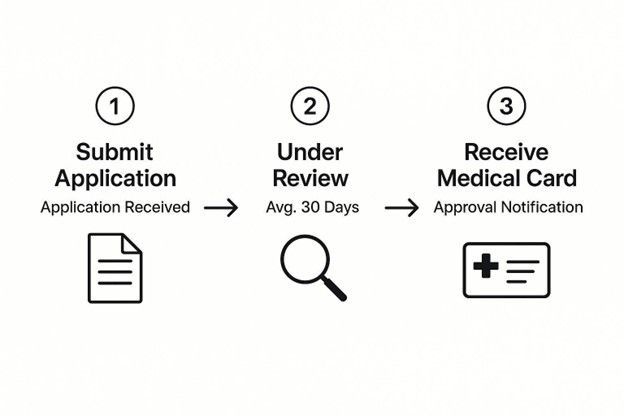
As you can see, the state typically takes up to 30 days to review a completed application. After that, they'll notify you of its approval, and you'll be on your way.
Common Questions About Mississippi Medical Cards
Whenever you're navigating a new program, a lot of questions are bound to pop up. As you move forward in getting your Mississippi medical card, it's completely natural to wonder about the specifics—the rules, how to use your card, and what happens next. We've put together some straightforward answers to the most common questions from patients in Mississippi.
Getting a handle on these details does more than just keep you on the right side of state regulations. It empowers you to use your medical marijuana card with total confidence. Knowing the rules upfront ensures everything goes smoothly as you start making medical marijuana a part of your wellness plan.
How Long Is My Medical Card Valid For?
Your Mississippi medical marijuana patient ID card is valid for one year from the day it's issued. It's not a one-and-done deal; you'll need to renew it annually to keep your status active in the program.
To stay current, you'll have to complete a renewal application and have a follow-up consultation with a qualified practitioner before your card expires. This yearly check-in is important—it makes sure your information is up to date and confirms that medical marijuana is still the right choice for your health needs. A great pro tip is to set a calendar reminder a month or two before your card’s expiration date. That way, you'll stay well ahead of the renewal process.
Can I Grow My Own Marijuana at Home?
This is probably one of the most frequent questions we hear, and the state's answer is a clear and simple No. The Mississippi Medical Cannabis Act does not allow patients or their caregivers to grow their own marijuana at home.
All therapeutic marijuana must be bought from a dispensary licensed by the state. This rule is in place to guarantee that every product you purchase meets the strict safety, quality, and potency standards set by the Mississippi State Department of Health. It’s a critical part of what keeps the program safe and reliable for every single patient.
After you submit your application and payment through the state's online portal, the Mississippi State Department of Health will begin its review. This process can officially take up to 30 days, though it is often faster. Once approved, you will receive an electronic medical marijuana card within five business days, which you can then use at any licensed dispensary in the state.
Are There Limits on How Much I Can Buy?
Yes, there are. Mississippi has set specific purchasing limits to make sure access is regulated and safe for everyone. The state uses a system built around Mississippi Medical Cannabis Equivalency Units, or MMCEUs.
Here’s how the limits break down for patients:
- You cannot buy more than six (6) MMCEUs in a single week.
- You cannot buy more than twenty-four (24) MMCEUs in a 30-day period.
Don't worry about having to track this yourself. Dispensaries are required to log all purchases through a statewide monitoring system. This system is designed to uphold the program's integrity and prevent anyone from stockpiling, which helps ensure there's a consistent supply available for all patients.
If you’re interested in learning more about the benefits of working with a trusted clinic, check out these
5 advantages of getting your medical marijuana card with us. This overview can give you extra peace of mind as you begin your journey.
At
Pause Pain & Wellness, we are committed to helping you find relief and improve your quality of life. Our local healthcare providers are here to guide you through every step, from your initial consultation to your final application. If you’re ready to take control of your health, visit us at
https://pausethepain.com to schedule your appointment today.